Three Dots and a Dash
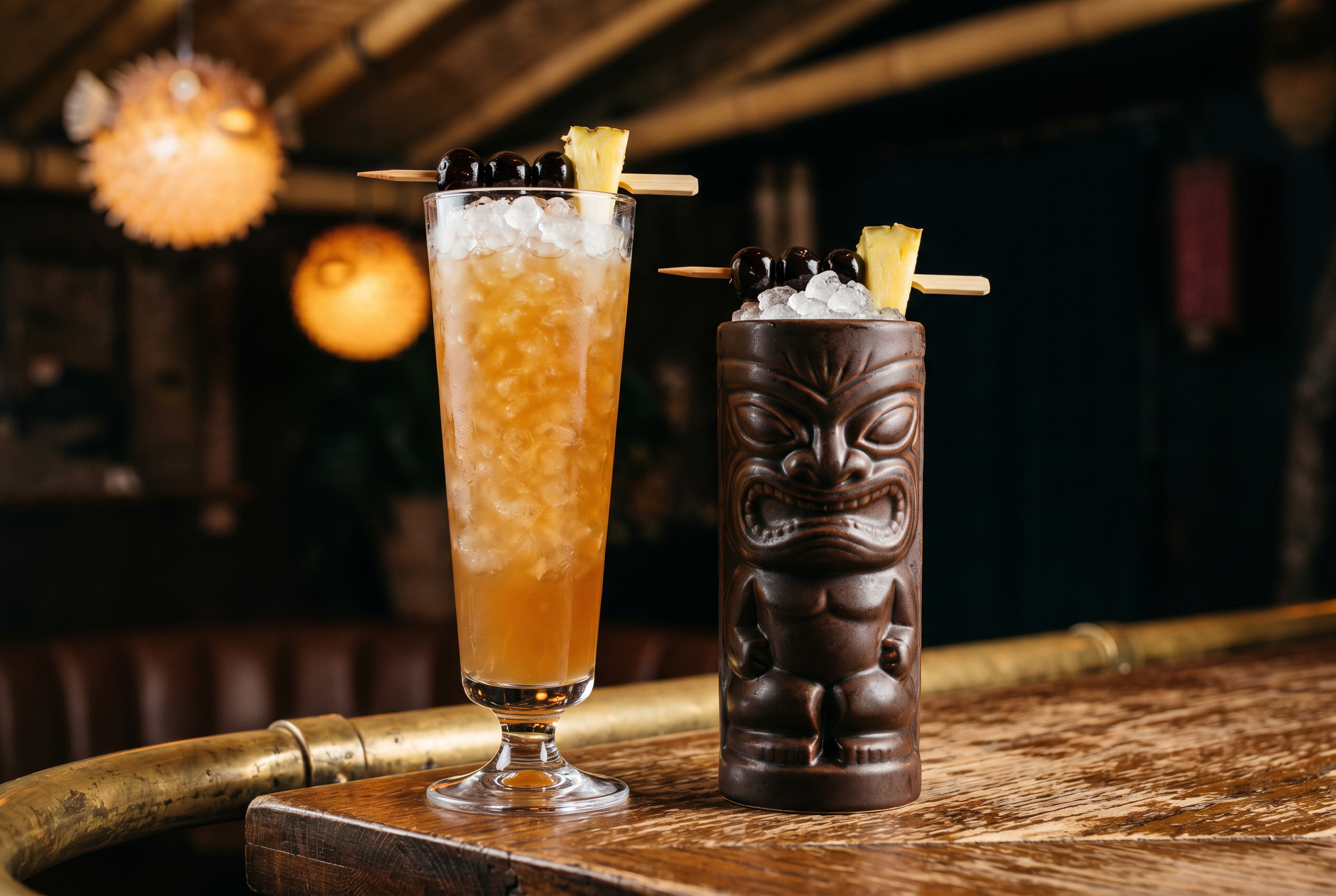
Donn Beach’s 1944 victory drink—the title is Morse code for ‘V.’ Two aged rums, falernum, honey, and a precise dash of Pernod, garnished with three cherries and a pineapple chunk that spell out the dots and the dash. Possibly the most complete exotic cocktail ever built.
The History
Created by Donn Beach in 1944 as a wartime tribute—the title (· · · —) is Morse code for the letter V, used by Allied broadcasts as a victory signal during World War II. The drink remained on Don the Beachcomber menus through the chain’s run and was reconstructed by Jeff Berry from staff notebooks for Sippin’ Safari. It’s the inspiration for Three Dots and a Dash, the celebrated Chicago tiki bar that opened in 2013.
Ingredients
- 0.75 oz fresh lime juice
- 0.5 oz fresh orange juice
- 0.5 oz John D. Taylor’s Velvet Falernum
- 0.25 oz honey syrup (1:1 honey to warm water)
- 1 oz aged rhum agricole (Rhum Clément VSOP or similar)
- 1 oz aged demerara rum (El Dorado 12 or similar)
- 1 dash Angostura bitters
- 1/8 tsp Pernod
- Crushed ice
Directions
Combine all ingredients in a blender with crushed ice.
Flash-blend on high for 5 seconds.
Pour everything into a tall glass.
Top with more crushed ice.
Garnish: three brandied cherries on a pick + one pineapple chunk arranged to spell the Morse code (· · · —).
Ceremonial Serve
The garnish is the drink. The name is Morse code for V (· · · —, the Allied victory signal during WWII), and the garnish encodes the same letter on a wooden pick across the rim of the glass. Skip the garnish and you’ve made the cocktail; you haven’t made the Three Dots and a Dash.
The skewer. Take a long wooden cocktail pick or a bamboo skewer. Thread three brandied cherries in a row near the pointed end—these are the three dots. Follow with one pineapple chunk (cubed, about the same size as a cherry)—this is the dash. The dash is always the last element. Cherry-cherry-cherry-pineapple. Not pineapple-cherry-cherry-cherry. Reversed is wrong.
The placement. Lay the skewer across the rim of the glass so the dots-and-dash read left to right from the drinker’s side. The reader is the drinker; orient accordingly. A guest looking at the drink across the table sees it backwards, which is fine—the drink is for the person holding it.
The mug option. The drink looks correct in a tall footed pilsner with crushed ice. It looks better in a dark-glazed carved tiki mug—Donn Beach-era replica silhouette, deep mahogany matte. Glass refracts light through the garnish and competes with the visual; a dark ceramic rim lets the cherry-cherry-cherry-pineapple sit cleanly across a contrasting surface, and the Morse code reads from across the room. See the Tiki Mugs guide for the pairing details.
The cherries matter. Brandied cherries (Luxardo or homemade) are the right move. Maraschino-bright neon-red supermarket cherries are not. The Morse code reads as red dots only if the dots are a real, deep red—not pink, not orange. Spend the $20 on a jar of Luxardo. They keep forever and they ruin you for the cheap kind.