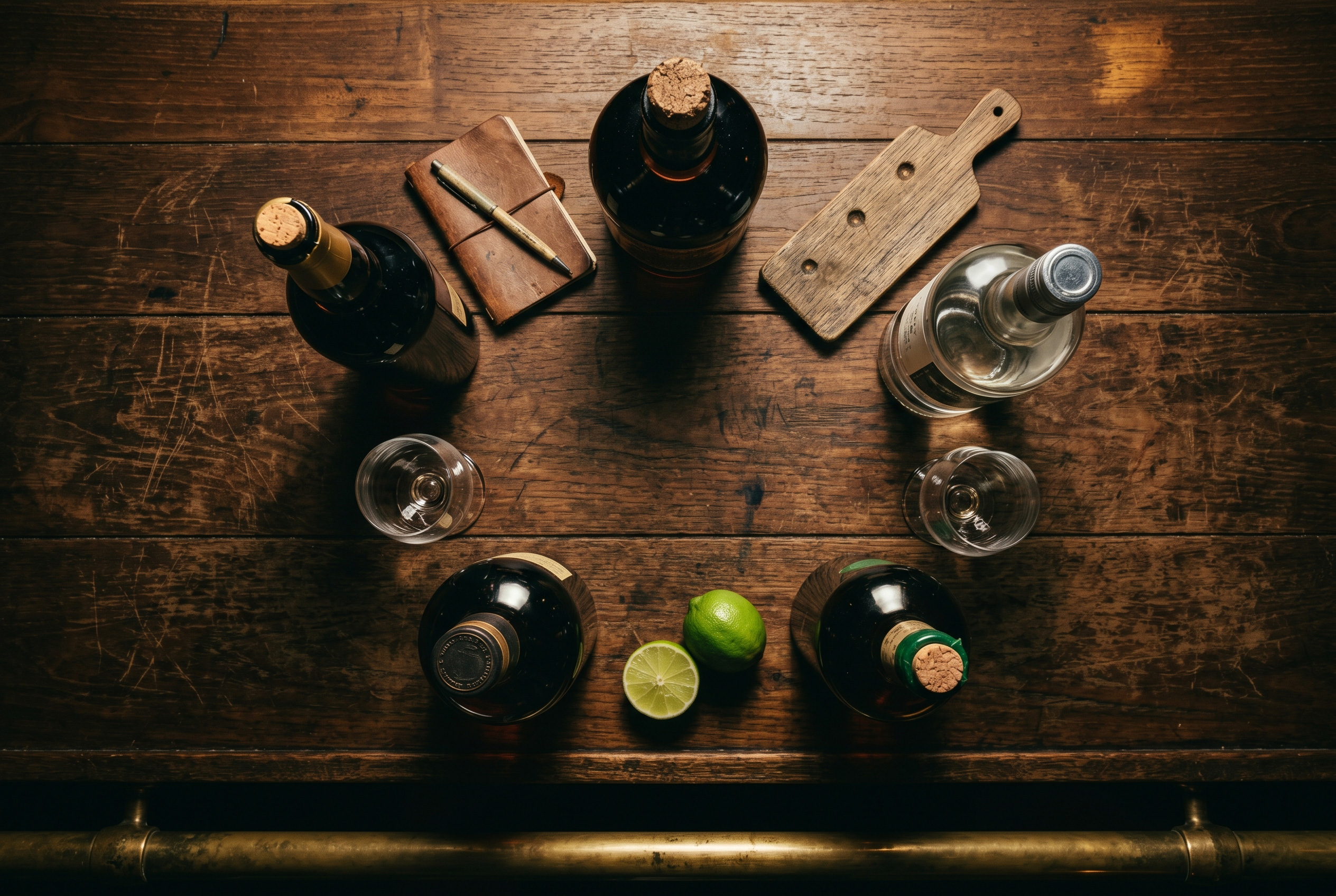
Rum is the engine of the genre. Almost every exotic cocktail is a rum drink, and “rum” as a category covers more terrain than vodka, gin, and tequila combined. The catch: the rum world spent most of the twentieth century being misrepresented by light-rum brands aimed at the daiquiri-as-spring-break market, and a serious bartender needs to unlearn most of what that era taught.
This guide is the working primer. What the categories actually are, which bottles anchor each category, and what to buy in what order for a home bar that can pour any cocktail on this site at the right level.
The five categories you actually need
Rum classification is contested—Spanish/English/French traditions, column vs pot still, light vs dark, agricultural vs molasses. For the home bar, five operational categories matter:
1. Aged Jamaican pot-still rum
The funk. The molasses-rich, ester-heavy, slightly-banana, slightly-rotting-pineapple aromatic profile that defines a serious Mai Tai, Zombie, or Jungle Bird. Made in copper pot stills (not column stills), aged in oak, full-bodied.
Bottles
- Smith & Cross the working-bar standard. Overproof (57%), unaged blend with heavy pot-still character. The single most-poured Jamaican rum in serious modern exotic bars.
- Hamilton Jamaican Pot Still Gold Ed Hamilton’s pot-still blend, ~$30 a liter. Slightly lower proof than Smith & Cross, slightly cleaner character, designed by Hamilton specifically for the modern cocktail revival.
- Wray & Nephew White Overproof 63%, unaged white pot-still. The Jamaican home-bar rum; what local bars actually serve. Use sparingly in cocktails (small splashes float on a Mai Tai); on its own it’ll tear your face off.
- Hampden Estate 8-Year the premium tier. Single-estate, named for the distillery (Hampden Estate is one of two remaining historic Jamaican pot-still distilleries). $45–55. Sip-worthy as well as cocktail-worthy.
For a Mai Tai: blend Smith & Cross with an aged Caribbean rum (see category 4). The funk comes from the Jamaican; the depth comes from the aged blend.
2. Demerara rum
The other pot-still tradition. Made in Guyana (the only producer is the Diamond Distillery, owned by DDL), aged in oak, distinctively molasses-heavy with a brown-sugar caramel character. The depth profile in many exotic cocktails—the bottom note in a Zombie, the dark layer in a Painkiller.
Bottles
- Hamilton 86 Guyana the workhorse. ~$25 a liter. The Demerara most modern exotic-cocktail bars pour by default.
- Lemon Hart 151 the historic Demerara, 75.5% ABV. The high-proof anchor for floats and flaming garnishes (the Zombie traditionally finishes with a Lemon Hart float lit on fire). Distinctive enough that substituting nothing else really works.
- El Dorado 12-Year DDL’s own aged Demerara, $35–45. Sippable, full-bodied, the high-end Demerara that doubles as cocktail rum and after-dinner pour.
For a Zombie: combine a Jamaican pot-still (Smith & Cross) with a Demerara (Hamilton 86) — the canonical Donn Beach reconstruction uses both, plus the Lemon Hart 151 overproof float.
3. Rhum agricole
The French tradition. Distilled from fresh sugar cane juice rather than molasses, made primarily in Martinique under the AOC Martinique designation. Grassy, vegetal, dry, completely different in character from the molasses-rum world. The signature ingredient in the Ti’ Punch and a meaningful component in the proper Mai Tai.
Bottles
- Rhum Clément VSOP aged agricole, $35–45. The standard mid-range bottle for cocktail use. Smooth, oak-influenced, retains the grassy agricole character but rounds the edges.
- Rhum JM Blanc — unaged agricole, $30–40. The cleanest expression of the cane-juice character. Use in cocktails calling for white rum where you want vegetal complexity rather than column-still neutrality.
- Neisson Rhum Blanc — premium unaged, $40–50. The connoisseur’s white agricole.
For a Mai Tai: split the rum half between aged Jamaican and aged agricole. Trader Vic’s 1944 spec called for 17-year J. Wray (now extinct); the closest modern reconstruction uses Smith & Cross + Rhum Clément VSOP.
4. Aged Caribbean blend (the workhorse category)
Most exotic-cocktail recipes call for “aged Caribbean rum” without specifying island. This is the bartender shorthand for medium-bodied, oak-aged, Spanish-or-English-tradition rum that delivers depth without competing with the more distinctive Jamaican or Demerara components.
Bottles
- Appleton Estate Signature Blend the everyday workhorse. Jamaican (column + pot still blend), 4–6 year aged, $25–30. The modern Mai Tai’s “aged Jamaican” component is most often this.
- Plantation 3 Stars (now Planteray) — Bajan/Jamaican/Trinidadian blend, white-but-aged, ~$25. The standard “white aged rum” for cocktails where you don’t want the funk of pot-still but you do want body.
- Banks 5 Island Trinidadian/Bajan/Jamaican/Indonesian blend, $25–30. Aged but column-still-heavy, clean and dry. The Tiki Tour-style modern bartender’s “blended white” — works in everything that doesn’t specifically need a heavier character.
- Foursquare Bajan single-blended (one of the few legitimately premium Caribbean rums made in column-still + pot-still combo). $40–60 for the aged expressions. The connoisseur tier.
For most exotic cocktails: this is the rum you reach for when the recipe just says “aged rum.” Appleton Signature is the safest default.
5. Light/white rum (Spanish tradition)
The Bacardi-style column-distilled white rum. Necessary for the Daiquiri, the Mojito, and a handful of other Cuban-tradition cocktails. Not what most exotic cocktails want—too clean, too neutral—but indispensable for the classics.
Bottles
- Bacardi Superior the historic Cuban white rum (now Puerto Rican production). $15–20. The cocktail-standard white.
- Havana Club 3-Year Añejo (where legal) — the Cuban-tradition standard. Better than Bacardi at similar price. Not legally available in the US.
- Plantation 3 Stars see above. Doubles for this category when you want a touch more body than Bacardi.
For a Daiquiri: Bacardi is fine. The drink is so simple that the rum-quality differential matters less than the lime-juice freshness.
Buy order (building from zero)
For a home bar starting empty, here’s the order of operations:
Bottle 1: Smith & Cross. $30. Unaged Jamaican pot-still. Unlocks the Mai Tai, the Jungle Bird, the funk-forward exotic-cocktail catalog. Single highest-impact bottle.
Bottle 2: Appleton Estate Signature. $25. Aged Jamaican blend. Pairs with Smith & Cross for the Mai Tai’s blended-rum requirement. Also sippable on its own.
Bottle 3: Hamilton 86 Guyana. $25. Demerara. Unlocks the Zombie, adds depth to any cocktail calling for “dark rum.”
Bottle 4: Bacardi Superior (or Plantation 3 Stars). $18–25. Light/white. Unlocks the Daiquiri and Mojito.
Bottle 5: Lemon Hart 151. $35. The overproof Demerara for floats and the Zombie finish.
Five bottles, ~$135 total, and you can make every canonical exotic cocktail on this site at a serious level.
Buy order (deepening from five)
When you’re ready to go past the working five:
Bottle 6: Wray & Nephew Overproof. The Jamaican home-bar rum. Small pours in Mai Tais; full pours for the Cobra’s Fang. $30.
Bottle 7: Hampden Estate 8-Year. $50. The Jamaican premium. Doubles as cocktail rum and sipping rum.
Bottle 8: Rhum Clément VSOP (agricole). $40. Unlocks the grassy-rum cocktail register. The Mai Tai gets more interesting; the Ti’ Punch becomes a possibility.
Bottle 9: El Dorado 12-Year. $40. Aged Demerara. Sipping-quality, also a great upgrade to any cocktail calling for “dark rum.”
Bottle 10: Foursquare (any aged expression). $50–80. The connoisseur Bajan rum. The bottle you pour for guests who care about rum.
Ten bottles, ~$350 total. You now have the rum shelf of a working revival-era exotic-cocktail bar.
What to skip
A few rums get a lot of bartender-marketing attention but aren’t worth the home-bar slot:
- Spiced rum (Captain Morgan, Sailor Jerry, etc.). Pre-spiced rum doesn’t substitute for the spice profiles cocktails actually need—make your own falernum and use unspiced rum instead.
- Flavored rum (coconut, mango, pineapple, etc.). Mostly artificial flavors layered on cheap base spirit. For coconut, use Coco López; for pineapple, use fresh juice; for any other fruit, use fresh juice or a quality syrup.
- Pyrat XO / Pyrat 1623. Heavily orange-flavored, mostly used by bars that haven’t found Plantation. Not what serious cocktails need.
- Bacardi 8 / Bacardi Reserva Limitada. Better than Bacardi Superior but not better than Appleton Signature at the same price tier. Skip.
- Most “premium” young rums under $40. The premium-rum aisle is full of marketing-driven brands with thin sourcing. The trustworthy operations (Foursquare, Hampden, El Dorado, the established Jamaican/Bajan/Guyanese houses) signal their provenance clearly.
Where to buy
For the home bar, two channels:
- Local liquor stores with a serious rum selection. Major US cities have at least one: Hi-Time in Costa Mesa, BevMo / Total Wine for breadth, K&L in California, Astor in NYC. Call ahead.
- Online retailers (where legal in your state). Caskers, Drizly, and Total Wine all ship to most US states. The hard-to-find Hamilton bottles often only show up online.
The buy-page entries for each bottle linked in this guide are in the Buy directory — every recommended rum on this guide has its own library profile + affiliate link.
Going deeper
When you’re ready to study rum as a subject rather than just an ingredient:
- The Complete Guide to Rum by Ed Hamilton (1997). The most comprehensive English-language rum reference, even thirty years later.
- Rums of the Eastern Caribbean by Ed Hamilton (1995). The country-by-country regional book.
- Smuggler’s Cove by Martin and Rebecca Cate (2016). Codifies the modern rum classification system. The single most influential rum-knowledge book of the modern era.
- Ministry of Rum Hamilton’s website, the running rum encyclopedia. Distillery profiles, producer news, and a long-standing forum.
Rum is the genre’s most rewarding subject of study. The categories above are the working shorthand; the books above are the deep dive.