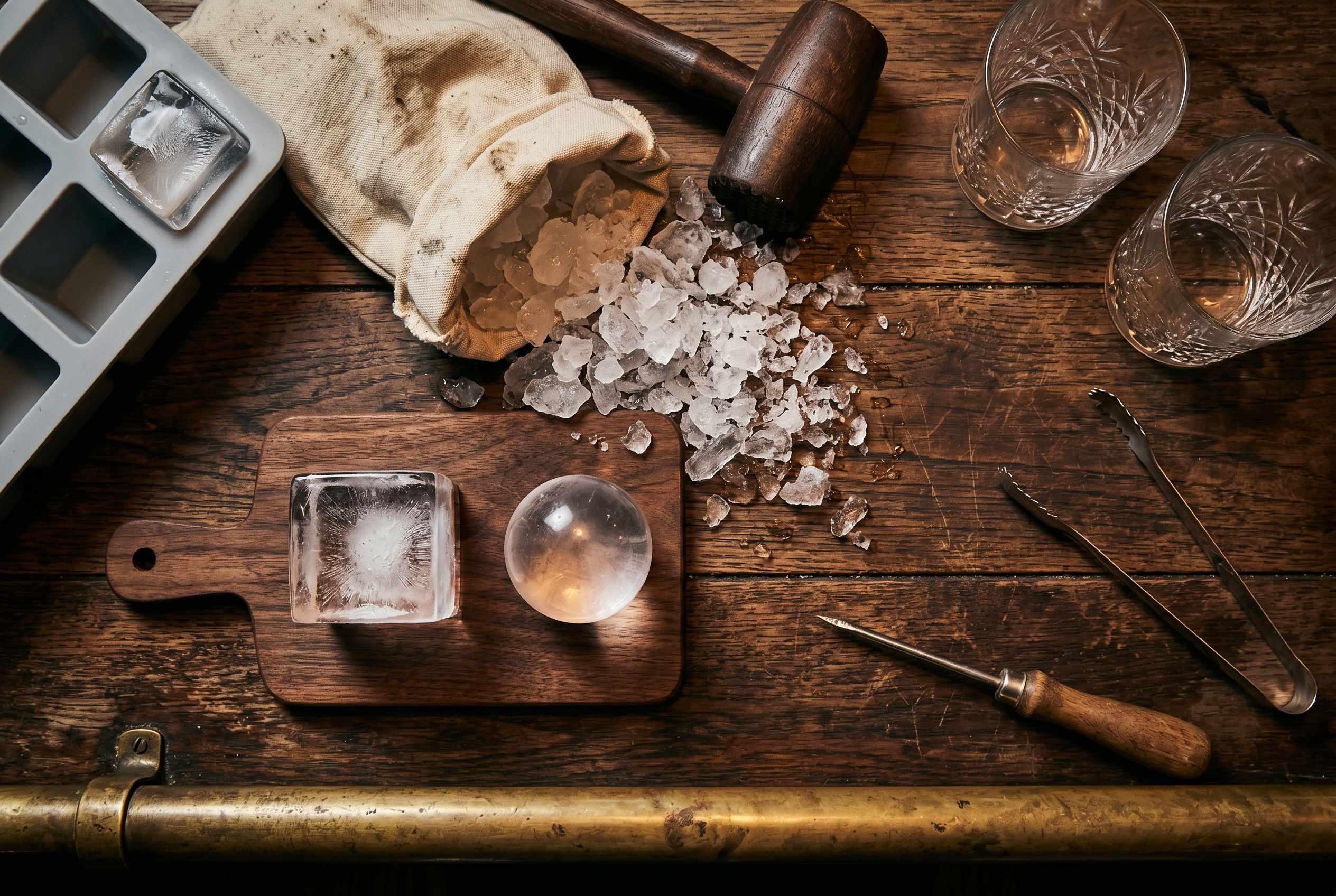
Ice is half the cocktail. Two bartenders can use identical ingredients in identical proportions and produce different drinks if their ice and technique differ. The shape of the ice determines how fast the cocktail chills, how much it dilutes, and how long it stays cold in the glass. The technique—shake, stir, swizzle, flash-blend, float—determines what kind of texture the drink lands with. None of this is in the ingredient list. All of it is in the recipe.
This guide is the working primer on ice forms, the techniques that pair with each, and the equipment that makes them work at home. Most of what separates a home-bar Mai Tai from a bar Mai Tai isn’t the rum. It’s this.
Ice is half the cocktail
When you shake a cocktail, three things happen at once: it chills, it dilutes, and it aerates. The ice does all three. A bigger surface area (crushed) chills faster and dilutes faster. A smaller surface area (a single large cube) chills slower and dilutes slower. The temperature you end up at and the water content you end up with are both products of how long you shake against what kind of ice. The recipe’s implicit assumption is that you used the right ice.
This is why a Daiquiri made with cracked ice tastes thin and a Daiquiri made with a Lewis bag of crushed feels right. It’s why a stirred Old Fashioned over a big single cube reads as concentrated and one over a fistful of small cubes reads as watered. The recipe’s proportions are calibrated against an expected ice form. Change the ice, you change the drink.
The ice forms
Cubed ice
The default. Commercial 1.25-inch cubes. Used in shaking, stirring, building over ice. The ice form most home bartenders default to without thinking about it.
Make at home. Any silicone or plastic tray works. Tovolo silicone trays are the cheap-and-decent default at about $10. Standard freezer trays make slightly smaller, cloudier cubes; serviceable but not pretty.
Upgrade. A small chest-style countertop ice machine (NewAir, Sentern, Frigidaire) makes respectable bullet-shape cubes at home for about $300 and is the single biggest upgrade most home bars can make. The professional answer is a Kold-Draft commercial machine, which produces large clear slow-melting cubes—out of scope for nearly everyone, but worth knowing exists.
Crushed ice
Required for most canonical Donn Beach flash-blended builds and for tropical-blender drinks generally. Fine enough to integrate visually with the cocktail; not so fine it over-dilutes in the first sixty seconds.
Make. A Lewis bag—a heavy canvas bag with a wooden mallet—is the cheap-and-correct way. Buy one for about $25 (Cocktail Kingdom makes the standard). Drop cubes in, fold the top, beat the bag against the counter for thirty seconds. You have crushed ice. The canvas absorbs meltwater so what comes out of the bag is dry, not slushy.
Don’t. A blender produces uneven, snowy crushed ice that over-dilutes immediately. A food processor is worse. A muddler smashes some cubes and ignores others. The Lewis bag is the right tool; spend the $25.
Cracked ice
Coarser than crushed, finer than cubed. The agitation form that works in some swizzles and in stirred-then-poured builds like the Bermuda Rum Swizzle and the original 1978 Jungle Bird. To make it, beat the Lewis bag for ten seconds instead of thirty. Or smash a few cubes with the flat of a heavy knife.
Block ice / single large cube
A single 2-inch cube, hand-chipped from a block or molded directly. Used in spirit-forward stirred drinks—Kingston Negroni, the canonical Old Fashioned, the Old Cuban—where slow dilution matters and the visual of one clean cube in a rocks glass is part of the serve.
Make. Tovolo and other manufacturers make 2-inch silicone cube trays for about $15. Boil-then-freeze the water in two stages for a clearer cube (the boil drives out dissolved air); a single overnight freeze of room-temperature filtered water also works. Hand-chipping from a clear block is the pro move and overkill for the home bar.
Pebble ice
Round, small, pearl-sized ice from a specialty machine (the GE Profile Opal, the consumer pebble-ice models). The texture is somewhere between crushed and cubed; it integrates beautifully with crushed-ice cocktails and looks correct in a tall glass.
A pebble-ice machine costs $400–700 and is a real luxury. Not necessary, but if you make a lot of tropical drinks and want bar-quality ice at home, it’s the upgrade past the Lewis bag.
The cone of ice
Donn Beach’s signature Navy Grog presentation. Crushed ice packed into a cone-shaped mold (a small metal funnel works, or a dedicated tiki ice-cone mold), frozen, with a straw threaded through the center axis. The drinker sips through the straw; the cone slowly dilutes around it.
The cone is a piece of cocktail engineering. Most crushed-ice cocktails over-dilute within ten minutes because the surface-to-volume ratio is huge. The cone holds longer because the ratio is smaller—and because the straw delivers the liquid from the bottom of the glass, pre-chilled by the cone, the drink stays cold to the last sip. See the Navy Grog Ceremonial Serve for the full protocol.
The techniques
The shake
Combine ingredients in a shaker tin with cubed ice. Shake hard for 10–12 seconds—hard enough that the tin frosts on the outside and you can hear the ice cracking against the wall of the shaker. The goal is three things at once: chill the cocktail, dilute it appropriately, and aerate it slightly. Most cocktails with fresh citrus juice want a hard shake.
A Boston shaker—two-piece, tin-and-tin or tin-and-glass—is the working bartender’s tool. Cocktail Kingdom’s weighted tin set is the home-bar default at about $40. A cobbler shaker (three-piece, with a built-in strainer cap) works fine for home use and is forgiving for new shakers.
The stir
Combine ingredients in a mixing glass with cubed ice. Stir gently with a long bar spoon for 20–30 seconds, keeping the spoon close to the wall of the glass so the ice rotates as a single column rather than tumbling. The goal is to chill and dilute without aerating—aeration is the wrong texture for spirit-forward cocktails like the Kingston Negroni, the Manhattan, the Old Fashioned.
Stirred drinks typically serve in a chilled coupe (the Negroni, the Manhattan) or a rocks glass over a single large ice cube (the Old Fashioned). Glassware does work the recipe can’t.
The swizzle
A Caribbean technique. Combine ingredients in a tall glass packed with crushed ice. Spin a multi-pronged swizzle stick rapidly between your palms; the prongs agitate the ice and the liquid until the outside of the glass frosts—usually 15 to 20 seconds. See the Swizzle library entry for the history.
The swizzle is the original Caribbean cocktail technique—predates shakers by a century. The agitation chills and dilutes simultaneously; the ice integrates with the cocktail texturally in a way that no shake produces. Used for the Bermuda Rum Swizzle, the original Jungle Bird, the Queen’s Park Swizzle, and a small set of canonical Caribbean cocktails that don’t want to be shaken.
A real swizzle stick—the five-pronged wooden tool the Cocktail Pirate Swizzle brand sells—is the right equipment. A long bar spoon works as a substitute and is the most common compromise. Don’t use a regular spoon; the geometry is wrong.
The flash blend
Combine ingredients in a blender with crushed ice. Blend on high for 3–5 seconds—just enough to integrate, not enough to homogenize. Pour everything (ice included) into the serving glass. See the Flash Blend library entry.
The flash blend is Donn Beach’s signature technique—the foundation of nearly every canonical Beachcomber build that isn’t shaken or built. Three Dots and a Dash, Zombie, Pearl Diver, Scorpion, and others all flash-blend. The texture is the goal: the cocktail integrates with shaved ice in a way that no shake produces, and the resulting drink has a granité-like body distinct from a smoothie (which is what a longer blend produces).
Use a standard countertop blender—Vitamix is the high-end answer but overkill; a Hamilton Beach or KitchenAid commercial-style blender is the working-bar default. The Hamilton Beach Drink Mixer (the malt-shake-style three-spindle machine) is the historically correct piece for canonical Donn Beach builds; see the Hamilton Beach Drink Mixer library entry. Optional and beautiful; a regular blender does the job.
The float
Pour a small amount (0.25–0.5 oz) of a separate spirit gently over the back of a bar spoon onto the surface of an already-built cocktail. Done correctly, the floated spirit sits visibly on top and delivers a distinct aromatic register to each sip. See the Float library entry.
Used for: the dark-rum float on a Mai Tai, the sherry float on a Fogcutter, the 151 float on several Donn Beach builds, the grenadine “fall” at the bottom of layered tropical drinks. The technique is the same; the spirit changes.
The bar-spoon-back-side trick: hold the spoon just above the surface of the drink, convex side up, and pour the float slowly onto the spoon’s back. The spoon dissipates the pour so the liquid settles instead of plunging through. With practice you can do it without the spoon, but the spoon makes it reliable.
The build
Combine ingredients directly in the serving glass over ice. No shaker, no blender. Used for highball-style drinks—Doctor Funk, Sailor’s Grog, the Mojito, the Suffering Bastard. The simplest technique; the hardest to do wrong, but also the hardest to do uniquely well. Pre-chill the glass, work with cold ingredients, stir gently to integrate.
The equipment
The minimum kit:
- Weighted Boston shaker tins (Cocktail Kingdom or similar, ~$40)
- A Lewis bag (~$25)
- A long-handled bar spoon (~$10)
- A Hawthorne strainer (~$15)
- A jigger—1 oz / 0.75 oz with internal hash marks, the Cocktail Kingdom Japanese-style is the working-bar default (~$15)
- A muddler—wood, blunt end (~$15)
- A blender—any countertop blender will work; if you’re upgrading, Vitamix is overkill, Ninja is fine
Total: under $150 for a kit that handles nearly every canonical recipe.
Past the minimum, the upgrades in priority order:
- A real swizzle stick. The Cocktail Pirate five-pronged hardwood model is correct; about $30. Unlocks the Caribbean swizzle category properly.
- A 2-inch silicone block-ice tray. Tovolo or similar; about $15. Old Fashioneds and stirred drinks improve immediately.
- A countertop ice machine. Sentern or NewAir bullet-style; about $300. Cleaner cubes, more of them, no freezer real estate.
- A Hamilton Beach Drink Mixer. The malt-shake-style three-spindle machine. Historically correct for Donn Beach flash-blended builds and gives the cocktail a distinctly different texture from a countertop blender. About $250 new; vintage models occasionally surface for less.
Pairing form to technique
The cheat sheet, condensed:
| Recipe asks for | Use this ice | Use this technique |
|---|---|---|
| Shaken with citrus | Cubed | Hard shake, 10–12 sec |
| Stirred, spirit-forward | Cubed | Stir gently, 20–30 sec |
| Caribbean swizzle | Crushed | Swizzle stick between palms, 15–20 sec |
| Donn Beach flash-blend | Crushed | Blender, 3–5 sec on high |
| Highball / built drink | Cubed (sometimes crushed) | Stir gently to integrate |
| Spirit-forward over rocks | Single 2-inch cube | None — built directly |
| Navy Grog | Crushed packed in a cone mold | Shake, pour over the cone |
| Punch / shared bowl | Crushed plus a center block | Stir in the bowl |
If the recipe doesn’t specify the ice, default to cubed for shaken/stirred and crushed for blended.
What to skip
- Slushy ice from a blender. The fastest way to over-dilute a cocktail in three seconds. Use a Lewis bag.
- Old freezer ice that’s absorbed kitchen smells. Ice is porous; it picks up garlic, onion, and freezer-burn notes. Use fresh ice in any drink you want to taste like the recipe.
- Pre-broken bagged crushed ice from a grocery store. Wet, uneven, full of meltwater. Lewis bag plus your own cubes.
- A shake that lasts 5 seconds. Under-shake is under-dilution; the drink will taste hot and unbalanced. 10–12 seconds minimum on any shaken cocktail with citrus.
- A stir that lasts 5 seconds. Same problem in the opposite direction—a spirit-forward stir wants real dilution, and that takes 20–30 seconds. Watch the outside of the mixing glass frost; that’s your cue.
- The shake-the-blender-pitcher technique. Not a thing. Blender goes on the base, not in your hands.
Where this goes next
Once the ice and the technique are right, the natural next read is Garnish & Theater—because the last variable that turns a built cocktail into a served cocktail is what goes on top. Or back to Syrups & Liqueurs if you’re working through the spirits-and-sweeteners side of the same project.