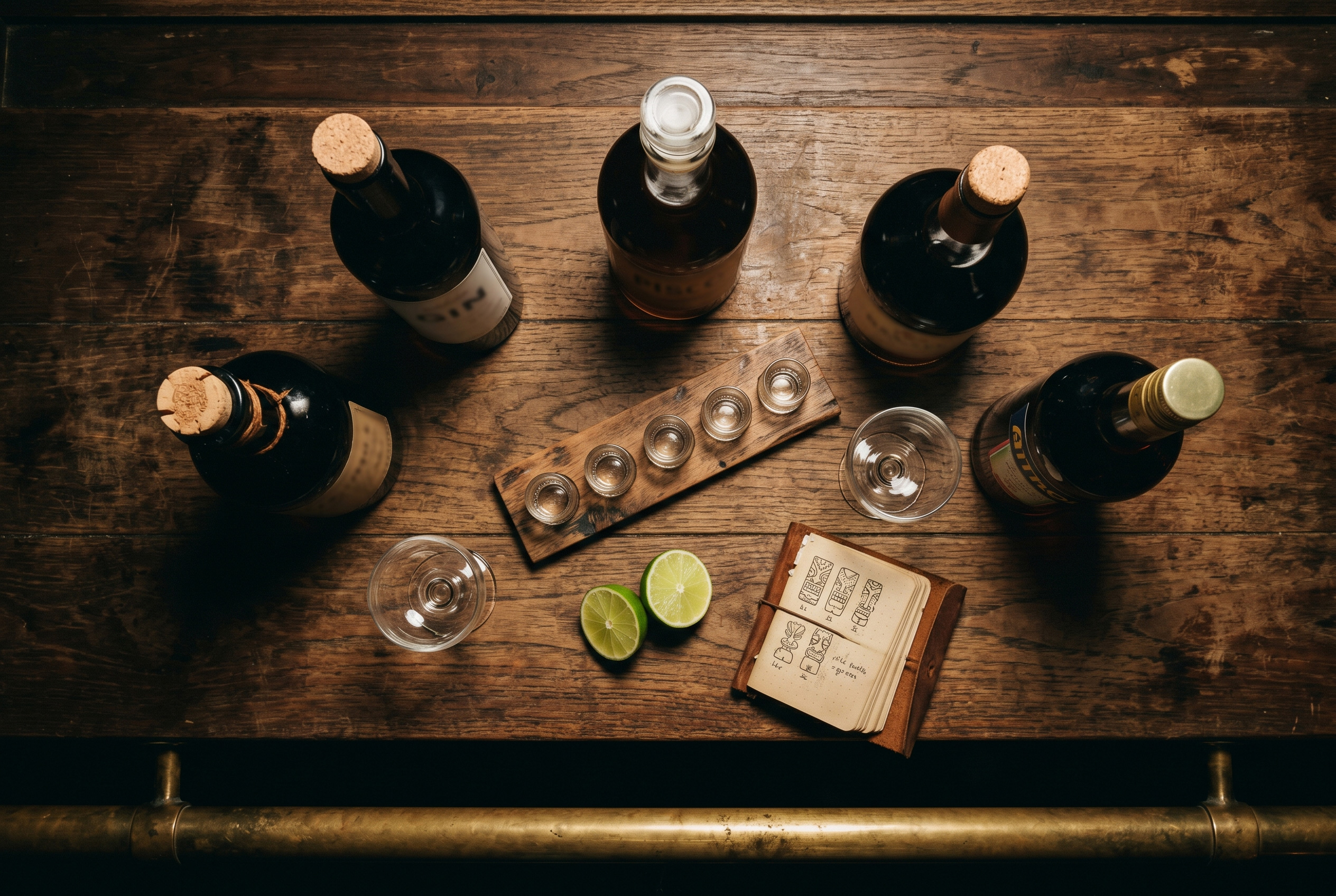
Rum dominates the genre but doesn’t own it. Several canonical exotic cocktails use other spirits — gin in the Saturn, brandy in the Fogcutter, tequila in the El Diablo, pisco in the Pisco Punch — and the multi-spirit Donn Beach and Trader Vic builds layer rum with gin, brandy, or both. A serious home bar needs at least a handful of non-rum bottles to make the canonical recipes that aren’t rum-only work.
This guide is the working primer on those bottles. What each spirit does in the exotic-cocktail context, the recipes that call for it, and the specific bottles worth keeping on the shelf. If you’ve worked through The Rum Guide, this is the natural complement.
Rum doesn’t own the genre
The exotic-cocktail tradition is overwhelmingly a rum tradition — most of the canon, most of the volume, most of the editorial energy. But the multi-spirit builds are some of the best drinks in the catalog. Vic Bergeron’s Fogcutter layers rum, gin, and brandy with a sherry float — a multi-spirit build that no single-spirit cocktail can match for complexity. Donn Beach’s reconstructions occasionally pull in gin or brandy. The mid-century Caribbean classics — Singapore Sling, Suffering Bastard — predate the tiki bar and use gin as the structural base.
The non-rum spirits in this guide aren’t exotic-cocktail spirits the way rum is. They’re working-bar spirits that exotic-cocktail recipes occasionally reach for. The bottles below are picked for that context — what makes them work in a Fogcutter or a Saturn, not what makes them work in a Negroni or a Manhattan.
Gin
The second most-used spirit in the canon. Most of the gin in exotic cocktails is in multi-spirit builds; a handful of recipes are gin-forward.
Where gin appears:
- Saturn — Popo Galsini’s 1967 IBA World Cocktail Championship winner. The gin-forward exotic cocktail, with passion fruit, orgeat, lemon, falernum.
- Fogcutter — Trader Vic’s 1947 multi-spirit build (rum + brandy + gin + lemon + orange + orgeat, with a sherry float).
- Singapore Sling — Ngiam Tong Boon’s 1915 Raffles Hotel original (gin + cherry brandy + Cointreau + Bénédictine + pineapple + lime + grenadine).
- Suffering Bastard — Joe Scialom’s 1942 Cairo hangover cure (gin + brandy + lime + Angostura + ginger beer).
- A’a’po’e — the house gin-and-rum hybrid with passion fruit and tiki spices.
Bottles worth knowing:
- Plymouth Gin — the working bartender’s default. Softer and rounder than London Dry, with a slightly sweeter herbal backbone that integrates cleanly with tropical-fruit builds. The canonical gin for cocktail use; if you have one bottle of gin on the bar, this is it.
- Beefeater London Dry — the bright, juniper-forward classic. Less expensive than Plymouth, more assertive — the gin reads through louder in mixed builds, which is what some recipes want. The standard cocktail-bar London Dry.
- Tanqueray London Dry — pine and juniper turned up further. Works when the gin should drive the build, which is rare in exotic cocktails but useful for the Negroni-adjacent crossovers.
- Hayman’s Old Tom Gin — the sweetened pre-Prohibition gin style, useful for older recipes that call for Old Tom specifically. Not necessary for most of the exotic canon; pick up when you start chasing pre-Prohibition reconstructions.
- Sipsmith London Dry — a higher-end modern London Dry; the upgrade if you’ve been making a lot of gin cocktails and want to feel the bottle.
What to skip: Bombay Sapphire (over-marketed; the cocktail tastes like the blue bottle), grocery-store “New American” gins with twelve botanicals (usually overwhelms the recipe), and any flavored gin (rose, citrus, etc. — wrong for cocktail use).
Brandy and cognac
Less central than gin, but required for several canonical multi-spirit builds.
Where brandy appears:
- Fogcutter — the third spirit in Vic’s multi-spirit build.
- Scorpion — Vic’s 1947 shared-bowl cocktail (rum + brandy + orange + lemon + orgeat).
- Suffering Bastard — the brandy half of the gin-and-brandy backbone in Scialom’s original 1942 spec.
- Missionary’s Downfall — the peach-brandy variant.
Bottles worth knowing:
- Pierre Ferrand 1840 Original Formula — French cognac at cocktail-friendly price ($35–40). The working-bar default for any recipe calling for cognac or VS-grade brandy. The same house makes the Dry Curaçao the Mai Tai calls for; one library entry covers both.
- Hennessy V.S. or Rémy Martin V.S. — the mainstream VS cognacs, perfectly fine for cocktail use, slightly more expensive than the Pierre Ferrand without being meaningfully better in mixed drinks.
- Laird’s Bonded Apple Brandy — American apple brandy at 100 proof. Useful for cocktails that benefit from the apple register; some modern Suffering Bastard variants use Laird’s instead of cognac.
- Mathilde Peach or Briottet Peach — peach brandy for the Missionary’s Downfall. The Mathilde is the modern reference; the Briottet is the slightly higher-end alternative, both real fruit-based brandies rather than candy liqueurs.
What to skip: Anything labeled “California brandy” at supermarket grade, generic flavored brandies (apricot brandy ≠ apricot liqueur — see the Syrups & Liqueurs guide for the apricot liqueur distinction), and ultra-aged cognacs ($150+) for cocktail use. The recipe doesn’t pull the nuance out of the older cognac; save the Hennessy XO for sipping.
Tequila and mezcal
A small but real presence in the canon, growing through the revival era.
Where tequila appears:
- El Diablo — Trader Vic’s 1946 Mexican-themed build (tequila + crème de cassis + lime + ginger beer). Vic was thinking about tequila as a tropical cocktail base 60 years before the broader cocktail world caught up.
- Modern revival tropical-tequila builds — the modern-bar updates that take Vic’s precedent and run with it. Less canon, more contemporary.
The mid-century tradition didn’t use tequila much. Most of the tequila cocktails on this site are either Vic’s originals or modern revival creations.
Bottles worth knowing:
- Espolòn Blanco — reliable, widely available, properly agave-forward, cocktail-priced ($25). The working-bar default for a tequila that respects the recipe.
- Espolòn Reposado — the same house aged briefly. Modest oak; useful for the El Diablo when the original spec called for reposado.
- Tapatío Blanco — funky, characterful, the bartender’s tequila. Beloved by craft bartenders who want the agave note turned up. Slightly more expensive than Espolòn and worth it.
- Tequila Ocho — the upmarket working-bar tequila. Single-estate vintages; real agave; the cocktail-friendly upgrade past Espolòn.
- Siete Leguas — the historical Patrón source; smaller production, more character than Patrón, similar price.
For mezcal: the modern revival increasingly calls for mezcal by name in specific cocktails, but mezcal is largely outside the canonical exotic-cocktail tradition. Del Maguey’s Vida is the working-bar default if a recipe calls for mezcal; otherwise it’s a sipping category.
What to skip: Patrón (over-marketed; cocktail-priced versions exist that do the same job), 1800 (industrial), Jose Cuervo Gold (flavored, sweetened, not real tequila).
Pisco
The Peruvian grape brandy that anchors the Pisco Punch and a small set of related South American–origin builds.
Where pisco appears:
- Pisco Punch — the San Francisco classic from Duncan Nicol’s Bank Exchange Saloon (1893). Pisco + pineapple gum syrup + lime + fresh pineapple.
- A few revival-era pisco builds; otherwise the category is narrow.
Bottles worth knowing:
- Macchu Pisco — the workhorse Peruvian pisco. Widely available, cocktail-priced ($25–30), properly aromatic.
- Barsol Quebranta — fuller-bodied; particularly good for the Pisco Punch where the grape character should read clearly through the pineapple.
- Caravedo Mosto Verde Acholado — the upgrade tier. Cocktail-worthy and sippable; the choice if you want one bottle that handles both.
Note on Peruvian vs Chilean pisco: they’re different spirits with the same name. Canonical pisco cocktails are Peruvian. Chilean pisco is fine but not what the recipes mean.
Bourbon and rye
Largely absent from the canonical exotic-cocktail set, with one significant exception: the U.S. variant of the Suffering Bastard substituted bourbon for brandy in the mid-twentieth century. Forbidden Altar follows Joe Scialom’s original 1942 gin-and-brandy spec, but a bourbon-and-gin Suffering Bastard is the more common American-bar version and is a legitimate variant.
Modern revival cocktails occasionally use bourbon — the Coconut Mint Julep is a Southern crossover into the exotic-cocktail vocabulary — but bourbon is mostly a craft-cocktail-world spirit rather than an exotic-cocktail one. Don’t prioritize bourbon on the exotic-cocktail shelf; if you already have a bourbon for the broader bar, it’ll cover the few exotic-cocktail use cases.
Bottles worth knowing (if you don’t already have bourbon on the bar): Buffalo Trace, Wild Turkey 101, Old Forester 100 — any of these reads correctly in a Suffering Bastard substitution.
Vodka
The Chi-Chi (vodka + pineapple + cream of coconut) is the canonical vodka exotic cocktail — a 1960s rise-of-vodka adaptation of the Piña Colada. The Blue Hawaii sometimes uses citrus vodka in its modern serve.
That’s about the extent of vodka’s footprint on this site. The genre largely passed vodka by; the bottle is on the shelf for the rare recipe that asks for it.
Bottles worth knowing: Tito’s Handmade Vodka or any clean neutral grain spirit. Vodka choice has almost no impact on a Chi-Chi; spend $20, move on.
Buy order beyond rum
If you’ve worked through the rum shelf and are building out the multi-spirit canon, the priority order:
- Plymouth Gin ($30) — unlocks the Saturn, Fogcutter, Singapore Sling, Suffering Bastard, A’a’po’e. The single highest-leverage non-rum bottle.
- Pierre Ferrand 1840 ($35) — the third spirit in the Fogcutter and the brandy half of the Scorpion and Suffering Bastard. The Mai Tai’s curaçao comes from the same house if you need to buy them together.
- Espolòn Blanco ($25) — the El Diablo and the modern tequila-tropical category.
- Macchu Pisco ($25–30) — the Pisco Punch and the small set of pisco builds.
Four bottles, about $115 total, unlocks the multi-spirit and non-rum canonical recipes on this site.
The second-tier bottles to add as the bar deepens: Tapatío or Tequila Ocho (for the tequila upgrade), Mathilde Peach (for the Missionary’s Downfall), Laird’s Bonded (for the Suffering Bastard apple-brandy variant), Cherry Heering (technically a liqueur — see Syrups & Liqueurs — but functions as the second spirit in the Singapore Sling).
What to skip
- Flavored vodkas, gins, and rums for cocktail use. Vanilla vodka, cucumber gin, mango rum — these are mass-market sweetened liqueurs masquerading as base spirits. The recipes are calibrated against unflavored bases; flavored bottles wreck the balance.
- Ultra-premium bottles for cocktail use. A $200 cognac in a Fogcutter is wasted; the recipe doesn’t pull the nuance out. Save the upmarket bottles for sipping.
- The “tropical cocktail rum-substitute” marketing category. Some brands sell a “rum-style spirit” or a “Caribbean-style cocktail base” aimed at people who don’t want to buy real rum. Skip. The bottle is corn syrup with flavoring.
- Generic supermarket-brand brandy. The cocktail will taste of the brandy; choose a bottle you’d sip rather than one that’s only there because it was cheap.
- Bourbon-as-substitute-for-rum. Modern American bars sometimes default to bourbon when a recipe says “dark rum” because the bourbon shelf is bigger. Don’t. The recipes are calibrated against rum; bourbon makes a different drink.
Where this goes next
The spirits shelf and the syrups shelf together cover the bottle side of the canon. The next read is the Where to Buy guide for the actual sourcing — bottle shops, online retailers, the affiliate programs that route Forbidden Altar’s commerce. Or back to The Rum Guide if the rum shelf still needs filling out.