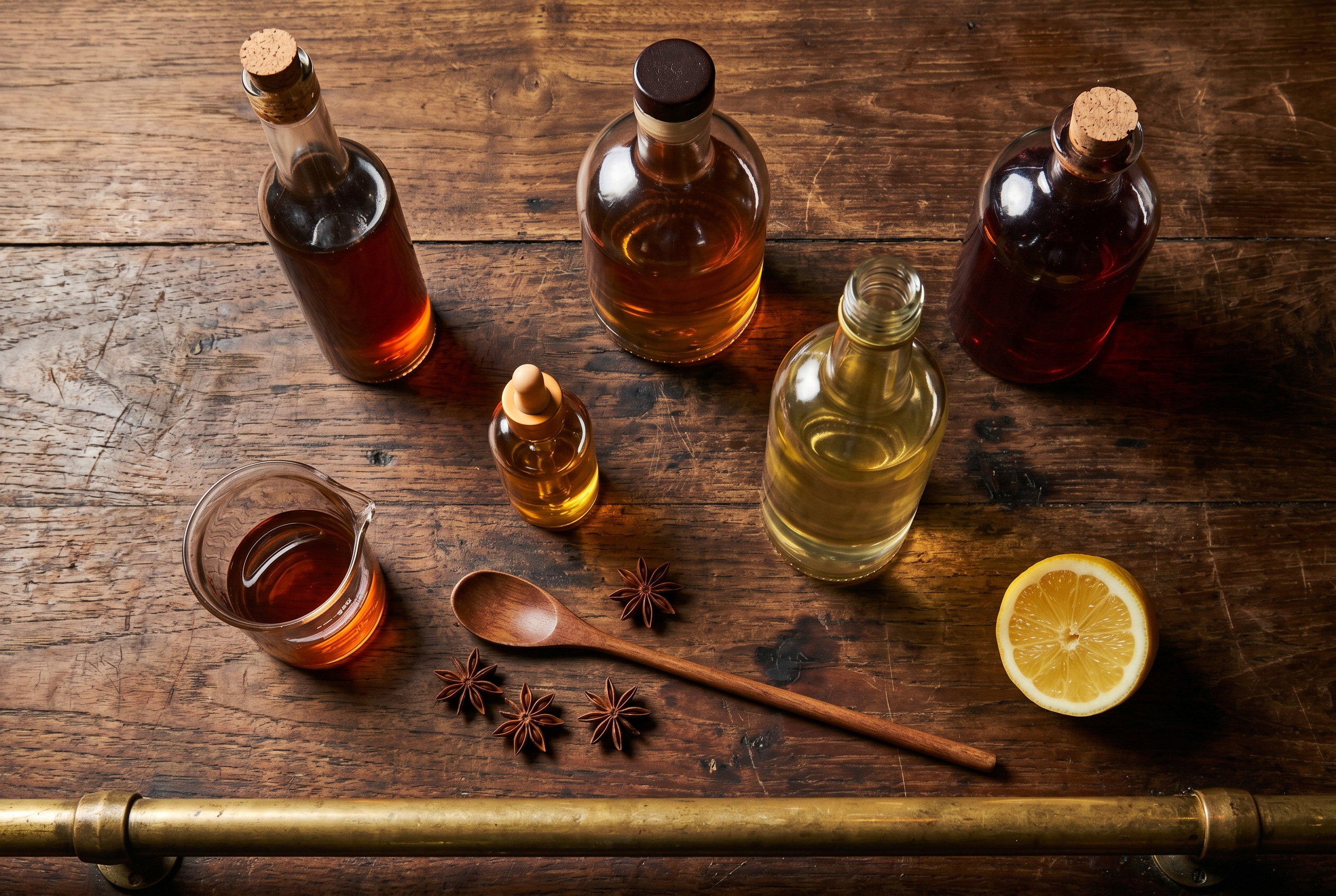
Beyond rum, this is the genre. Exotic cocktails are defined as much by their sweetener-and-modifier vocabulary as by their rum content. Orgeat in the Mai Tai. Falernum in the Three Dots and a Dash. Demerara syrup across half the canon. Pernod in the Donn Beach reconstructions. Curaçao, maraschino, Heering—each does a specific thing the rum can’t do.
This guide is the working primer on the syrups (the sweeteners) and the liqueurs (the alcoholic modifiers) that define the category. What each one is, which bottled version to buy, which you’ll want to make at home, and what to buy first if you’re starting from zero.
What syrups do
The job of a syrup in an exotic cocktail is structural, not just sweet. A syrup carries sweetness plus a flavor of its own—almond, clove, pomegranate, demerara molasses—that has to land in balance against the rum’s funk and the citrus’s acid. The wrong syrup tanks a drink as fast as the wrong rum. Orgeat in a Mai Tai isn’t there to sweeten; it’s there to bring the nutty marzipan note that the rum-lime-curaçao trio can’t make on its own. Falernum in a Three Dots isn’t there to sweeten; it’s there to bring clove and ginger that turn a sour-shaped build into something distinctly Caribbean.
This is also why mass-market syrups—the Monins and Toranis that dominate coffee-shop shelves—don’t work in serious cocktail context. They’re built around sugar with a flavor topnote stapled on. The good syrups are built the other way: they’re a flavor carried in sugar. The bottle matters.
The five syrups you actually need
Orgeat
The single most important syrup in the genre. Almond-and-orange-flower based, viscous, sweet with a marzipan-adjacent nuttiness that no other syrup can fake. Defines the Mai Tai. Appears in the Fogcutter, Scorpion, Saturn, Coconut Mint Julep, and dozens of others.
Buy: BG Reynolds Orgeat is the workhorse—widely available, properly almond-forward, no corn syrup. Liber & Co. and Small Hand Foods are the higher-end alternatives, both excellent. Avoid Monin and Torani; they’re sugar-with-almond-extract, not orgeat.
Make: Worth doing once. Forbidden Altar’s homemade orgeat is the Smuggler’s Cove double-strain method—about three hours of mostly-passive time. The flavor difference is real: fresher, more almond-forward, slightly less sweet. If you make Mai Tais regularly, it’s worth the afternoon.
Falernum
A Caribbean clove-and-ginger syrup, sweet with a bitter edge from the spices. Defines a large chunk of Donn Beach’s catalog—Three Dots and a Dash, Cobra’s Fang, Test Pilot, Saturn, Bermuda Rum Swizzle, Sailor’s Grog, and others.
Buy: John D. Taylor’s Velvet Falernum is the default. It’s a Barbadian product, low-ABV (11%), the bottled standard since the mid-twentieth century. BG Reynolds Don’s Spices #2 is a non-alcoholic spicier alternative; many serious bartenders keep both.
Make: Forbidden Altar’s homemade falernum follows Jeff Berry’s canonical Sippin’ Safari recipe—a two-day infusion of cloves, ginger, lime zest, and almonds in overproof rum, then sweetened. More clove and lime than the Velvet product, slightly hotter. Worth making once you’ve worked through your second bottle of the bottled stuff and want to see what the spicier version does to the Cobra’s Fang.
Demerara syrup (rich simple)
A 2:1 sugar-to-water syrup, traditionally made with demerara raw cane sugar for the molasses note. Required by name in the canonical Mai Tai and the Ribalaigua Daiquiri, and used across many Donn Beach builds as the house sweetener.
Buy: Skip. This is the easiest syrup in the genre to make—five minutes on the stove.
Make: Combine 2 cups demerara sugar with 1 cup water in a small saucepan. Heat gently while stirring until dissolved. Cool. Bottle. Keeps a month refrigerated. See Forbidden Altar’s homemade rich simple syrup for the full method. Don’t substitute white sugar—the molasses notes in the demerara are part of the recipe.
Passion fruit syrup
The aromatic backbone of several canonical builds: Hurricane, Cobra’s Fang, Zombie Punch, Shark’s Tooth, A’a’po’e. The bottle does a lot of work for you—passion fruit is hard to source fresh in most of the country, and the unsweetened pulp is more acid than aromatic.
Buy: BG Reynolds Passion Fruit Syrup is the workhorse. Liber & Co. and Small Hand Foods are the upgrades. Look for real passion fruit content in the ingredients; the mass-market “tropical” syrups are corn syrup, yellow dye, and citric acid.
Honey mix (honey syrup)
A 1:1 dilution of honey in warm water. Honey is too viscous to integrate directly in a shaken cocktail—it lumps. The dilution makes it workable. Required for the Navy Grog, QB Cooler, and Three Dots and a Dash. See Forbidden Altar’s homemade honey mix.
Make: Always. Honey mix doesn’t keep well (a week refrigerated) and there’s no bottled product worth recommending. Five-minute prep, no shortcut, do it the morning you’re going to use it.
The second shelf
Past the five essentials, the syrups you’ll want next:
Cinnamon syrup. Required for Don’s Mix—the prep-batched grapefruit-and-cinnamon syrup that defines the canonical Zombie. See Forbidden Altar’s homemade cinnamon syrup. No bottled product worth recommending; make it fresh.
Ginger syrup. Required for the QB Cooler and a handful of modern builds. Fresh ginger juice plus sugar, gently warmed. Keeps two weeks.
Grenadine. Pomegranate-based, not the corn-syrup-and-red-dye supermarket product. See the Grenadine library entry for the full story. Small Hand Foods is the working default; Liber & Co. is the upgrade. Both are real grenadine—pomegranate juice, sugar, orange flower water—and both will ruin you for the cheap stuff.
Gardenia Mix. Donn Beach’s house compound—butter, honey, vanilla, cinnamon, allspice—that anchors the Pearl Diver. See Forbidden Altar’s homemade Gardenia Mix. No bottled version. Make a small batch when you’re going to make Pearl Divers.
The liqueurs
Liqueurs are alcoholic—usually 15–40% ABV—and bring their own structural weight to a drink. They’re not interchangeable with syrups.
Curaçao (orange)
Orange-peel liqueur, traditionally from the Dutch Caribbean. The Mai Tai’s third ingredient after rum and lime.
Buy: Pierre Ferrand Dry Curaçao is the canonical modern bottle—the one Martin Cate specifies in Smuggler’s Cove and the one most modern bartenders reach for. Cointreau works as a higher-priced alternative; it’s technically triple sec but functionally the same role. Avoid generic bar-mixer “triple sec”—too sweet, too thin, no orange backbone.
Maraschino liqueur
Clear, dry, herbal—not the bright-red cherry product, despite the name. See the Maraschino Liqueur library entry. Anchors the Hemingway Daiquiri and the Mary Pickford.
Buy: Luxardo Maraschino Originale. The straw-wrapped bottle. No real alternative; this is one of the few categories where the canonical bottle is also the only one worth buying.
Heering cherry brandy
Danish cherry-and-brandy liqueur, deeper-red and slightly bitter. Defines the Singapore Sling and shows up in modern Donn Beach reconstructions.
Buy: Heering. Period. Cherry Heering has been made the same way since 1818; no substitute reads correctly in the Singapore Sling.
Bénédictine
Herbal, honeyed, slightly bitter French liqueur made by monks since 1510 (genuinely). The defining herbal note in the Singapore Sling and several modern Donn Beach builds.
Buy: Bénédictine. The B&B (Bénédictine and Brandy) variant is a separate product—stick with straight Bénédictine for cocktail use.
Pernod / pastis
Anise-based French aperitif, the technique-defining ingredient in canonical Donn Beach builds. Six drops in the Zombie. Quarter ounce in the Doctor Funk. A whisper in the Cobra’s Fang. See the Pernod library entry for the absinthe-vs-pastis distinction Donn Beach exploited.
Buy: Pernod. Herbsaint (New Orleans) and Ricard work as substitutes but read slightly different. Absinthe-proper (Vieux Carré, St. George) is bigger and bolder—use a lighter hand if you sub.
Apricot liqueur
The aromatic stone-fruit modifier in the Hotel Nacional Special and a handful of revival builds.
Buy: Rothman & Winter Orchard Apricot is the modern reference—real apricot, no candy notes. Marie Brizard Apry is the older bottled standard if you can find it.
Homemade vs bottled
The honest rule: make the syrups that keep well and have no good bottled equivalent (demerara, falernum, gardenia mix, cinnamon syrup, honey mix). Buy the ones where a serious producer beats homemade or matches it (orgeat, passion fruit, grenadine).
Falernum is the genuine border case. The Velvet bottle is real and good; the Jeff Berry homemade is different and arguably better in clove-heavy drinks. Make it once and decide.
Anything fresh-citrus-based (lime juice, lemon juice, grapefruit juice) is always homemade. There is no bottled substitute. The bottled lime juice you’re tempted to buy will ruin every drink it touches.
Buy order from zero
If you’re building from scratch, the priority order across syrups and liqueurs together:
- Orgeat (BG Reynolds) — unlocks the Mai Tai family
- Velvet Falernum (John D. Taylor’s) — unlocks most of the Donn Beach catalog
- Pierre Ferrand Dry Curaçao — Mai Tai third ingredient, also the Goombay Smash, Suffering Bastard
- Coco López (Coco López) — technically cream of coconut, not syrup, but essential for the Piña Colada, Painkiller, Coconaut, Chi-Chi
- Luxardo Maraschino Originale — Hemingway Daiquiri, Mary Pickford
- Real grenadine (Small Hand Foods or homemade) — Zombie, Hurricane, Bahama Mama, Singapore Sling
- Pernod — the Donn Beach signature; once you have it, half the canon opens up
- Heering cherry brandy — Singapore Sling and modern revival reconstructions
- Passion fruit syrup (BG Reynolds) — Hurricane, Cobra’s Fang, Zombie Punch
- Bénédictine — Singapore Sling completes; some Donn Beach reconstructions
That’s roughly $200–250 in syrups and liqueurs and unlocks the working majority of the recipe catalog. Add the homemade demerara syrup, honey mix, and cinnamon syrup as the recipes call for them.
What to skip
- Bar-rail “triple sec.” Pierre Ferrand or Cointreau or nothing.
- Monin, Torani, and the rest of the coffee-shop syrup brands. Fine for a vanilla latte; not built for cocktail use. Their flavor profile is sugar-with-extract, not what the recipes are calibrated against.
- Bottled lime/lemon juice. Never. Fresh-squeezed within the hour.
- Pre-mixed “tropical” syrups. Anything labeled “tropical blend” or “tiki mix” is corn syrup, yellow dye, and citric acid. Avoid.
- Bottled grenadine that lists “high fructose corn syrup” first. Including most supermarket brands. The grenadine in your local liquor store is, with very few exceptions, not grenadine—it’s a candy-flavored sugar syrup. See the Grenadine library entry.
- Cherry liqueurs that aren’t Heering. Maraschino isn’t a substitute; cherry brandy from generic producers reads as cough syrup. Heering or skip the drink.
Where this goes next
When you’ve got the syrups and liqueurs shelf assembled, the natural next read is Ice & Technique—because once the bottles are right, the shake, the ice, and the dilution become the next variables that determine whether the cocktail in the glass matches the cocktail the recipe meant. Or back to The Rum Guide if you’re building the spirits shelf in parallel.