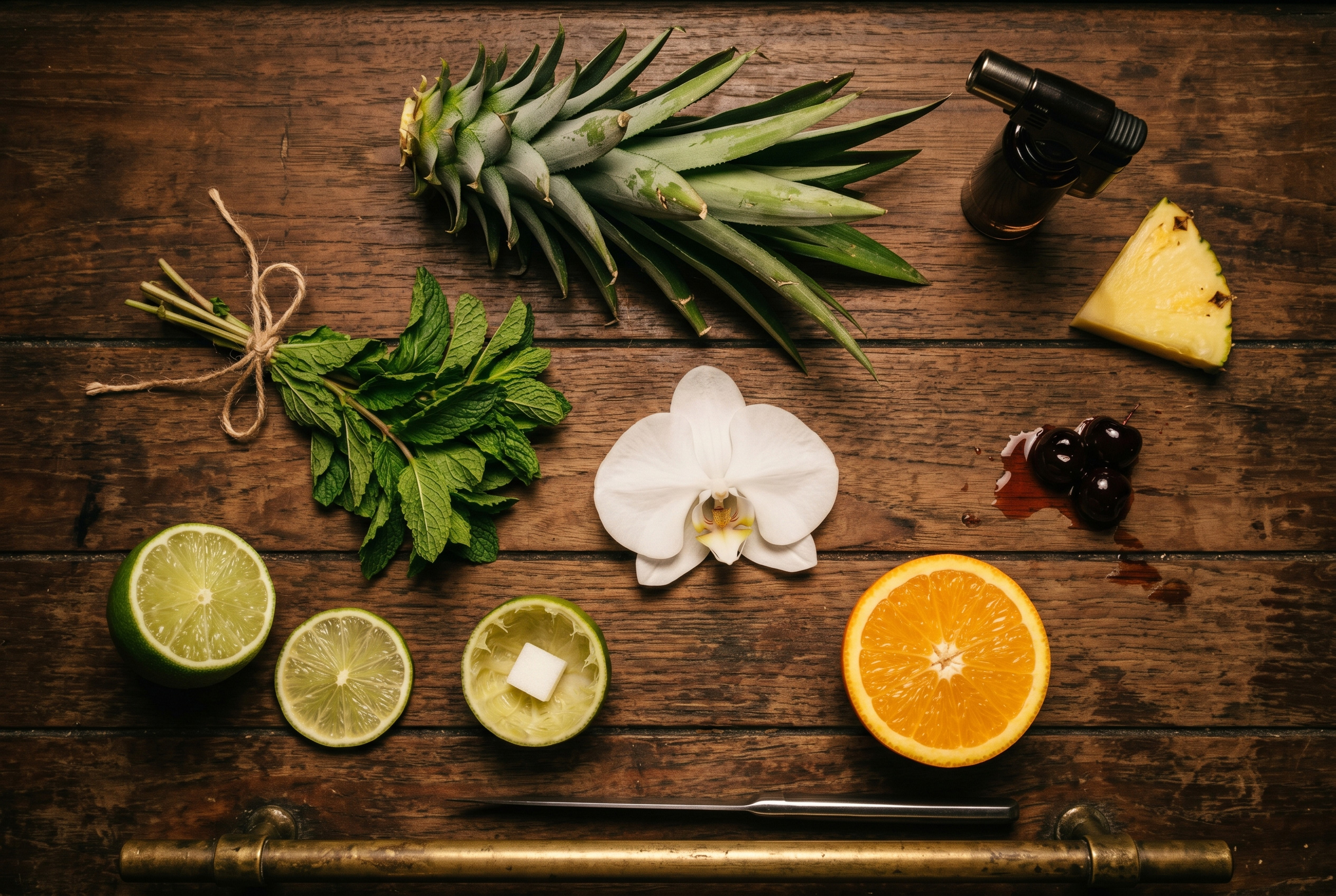
Tiki is theater. The drink can be perfectly built and the glassware can be exactly right, but the garnish is what tells the drinker they’re inside the genre rather than at a generic craft-cocktail room. The mid-century tradition developed a specific visual vocabulary—orchids, lime hulls, mint sprigs, paper umbrellas, oyster forks, fire—and the modern revival inherits and updates it.
This guide is the working primer on the canonical garnishes, the small set that are load-bearing for specific recipes (skip them and you’ve made a different drink), the theatrical moves that earn their cost, and the few that have become camp shorthand and are best used sparingly. The rule throughout: garnish that does editorial work the flavor doesn’t need is the point. Garnish that exists only as decoration—when nothing about the drink earns it—is the failure mode.
The visual vocabulary
Donn Beach and Trader Vic built much of the mid-century garnish vocabulary deliberately. Donn Beach used garnishes as branding—the orange-peel snake on a Cobra’s Fang, the oyster fork on a Test Pilot, the spent lime hull on his own Mai Tai precursors. Harry Yee at the Hilton Hawaiian Village introduced the vanda orchid in 1955 and the paper cocktail umbrella in 1959, both of which became cultural shorthand for the entire genre. Trader Vic codified the spent lime hull as the canonical Mai Tai presentation in his 1972 Bartender’s Guide.
The theatrical reading: every named garnish in the canon was an editorial choice that signaled something specific about the drink—the orchid said Hawaii, the umbrella said Polynesian Pop, the lime hull said Trader Vic, the snake said Don the Beachcomber. The garnish was the bar’s signature.
Most modern bartenders treat garnish as optional decoration. The Forbidden Altar position is that the canonical garnish is part of the recipe—and where the recipe calls for one specifically, the cocktail isn’t complete without it.
The canonical garnishes
Mint sprig
The single most-used garnish in exotic cocktails. Mai Tai, Mojito, Cobra’s Fang, Coconut Mint Julep, Doctor Funk, Sailor’s Grog, dozens more. The default top-of-glass move.
Use. A small sprig of three or four leaves, inserted into the crushed-ice mound at the top of the glass so the leaves rise vertically. Slap it lightly between your palms first to bruise the leaves and release the menthol oil. The aroma reads on every sip; without the slap, it’s just decoration.
Source. Fresh from a garden if you have one—mint is the easiest herb to grow and a single plant produces all the sprigs a home bar will ever need. Supermarket mint works in a pinch; choose bunches with stiff stems and dark green leaves. Spearmint is canonical (yerba buena in the Cuban tradition); peppermint is sharper, more aggressive, and reads as wrong in most exotic cocktails.
Spent lime hull
Specific to the Mai Tai, where it’s load-bearing—Vic published it as the canonical garnish in 1972 and the drink isn’t correct without it. Also used on the modern Mai-Tai-adjacent reconstructions.
Use. When you juice the lime for the cocktail, halve it and keep one half. After juicing, scoop the membrane and pulp out so the half is a clean cup. Float it on top of the crushed-ice mound, shell-side up—like a small green dome. The mint sprig goes inside the hull, leaves rising up.
Why it matters. See the Mai Tai Ceremonial Serve for the full editorial. The short version: the lime oil from the spent peel reads on the inhale, the mint reads on the sip, the green hull on top is the drink’s visual signature across a crowded bar.
Cherries
The Luxardo brandied cherry on a pick. Used on the Old Cuban, the Hurricane, the Pusser’s Painkiller, the Mary Pickford, the Test Pilot’s oyster fork, the Three Dots and a Dash’s Morse skewer, and a long tail of others.
Use. One or two on a wooden pick or skewer, laid across the rim. Multiple cherries get specific placement—the Morse code on the Three Dots and a Dash is three cherries then a pineapple chunk in a specific order.
Source. Luxardo Original Maraschino is the canonical jar—$20 for a 14-ounce jar, lasts months refrigerated, ruins you for the supermarket stuff. Jack Rudy and Tillen Farms are acceptable upgrades for the same money. The bright-red neon supermarket maraschino cherries are a completely different product; they don’t belong on a cocktail from this site.
Orange slice / orange wheel
The half-moon wheel, fresh-cut, about a quarter inch thick. Used on the Suffering Bastard, Sailor’s Grog, Hurricane, Bermuda Rum Swizzle, Bahama Mama, Pusser’s Painkiller—most of the dark-rum tropical Collins family.
Use. Lay on the rim, perpendicular to the glass; or float in the drink; or pin to a brandied cherry on a pick for the fruit-flag presentation (a Planter’s Punch standard).
Source. Fresh navel oranges. Cut just before service; old wheels look sad and the citrus oil oxidizes within a few hours.
Pineapple wedge with leaves
The pineapple wedge cut with one or two attached frond leaves rising up behind it. Used on the Jungle Bird, the Hotel Nacional Special, the Singapore Sling, the Goombay Smash—most pineapple-juice-based builds.
Use. Perpendicular to the rim, frond leaves rising vertically. The leaves are the visual; the wedge is edible.
Source. A whole fresh pineapple is enough garnish for ten cocktails. Cut wedges and reserve frond leaves the morning of service; both keep refrigerated for the day. The crowns from store-bought pineapples (the frond cluster at the top) work as supplemental garnish leaves.
Vanda orchid
Harry Yee’s 1955 invention at the Hilton Hawaiian Village—a fresh vanda orchid blossom floated on top of a tropical cocktail. The canonical garnish for many Hawaiian and Polynesian Pop drinks and a defining visual of the entire mid-century genre.
Use. Float a single bloom on top of the crushed-ice mound, dyed-side up. Don’t submerge—the cocktail’s alcohol breaks the petals down within an hour.
Source. Tropical-flower wholesalers carry vanda orchids; Honolulu and Miami florists ship them by the dozen; some specialty cocktail-supply stores carry edible orchids. Out of season they’re hard to source; gardenias and dendrobium orchids work as substitutes (the dendrobium is what the Tambu Lounge uses on the Lei Lani Volcano). Confirm food-safe and pesticide-free before floating any flower on a drink.
Fresh-grated nutmeg
Load-bearing for the Pusser’s Painkiller and the Planter’s Punch; also showpiece on the Bahama Mama and the Coconaut. Fresh-grated, not pre-ground from a jar.
Use. Grate three or four passes over the surface of the finished cocktail. The aromatic oils in fresh nutmeg are volatile—pre-ground has lost most of them.
Source. Whole nutmeg from any grocery store’s spice aisle—about $5 for enough nutmeg to last a year. A small microplane (a Microplane classic zester) is the right tool. Nutmeg-on-a-fingertip-grater is a serious cocktail-bar move.
Paper umbrella
Harry Yee’s other 1959 invention. The little paper cocktail umbrella, planted in the ice. Cultural shorthand for tropical cocktail in a way no other garnish quite matches.
Use. Sparingly. One per glass on a volume-cocktail tropical drink where you want the full Polynesian Pop theatrical commitment—a Mai Tai for a beach party, a Bahama Mama at a barbecue, a Painkiller at the pool. On a serious-bar cocktail it reads as kitsch.
Source. Restaurant supply stores; cheap, available in 100-pack bulk.
Load-bearing garnishes
A small handful of canonical garnishes are load-bearing for the recipe—skip them and you’ve made a different cocktail. The genre’s rare cases where the garnish does work the flavor doesn’t.
| Recipe | Garnish | Why it’s load-bearing |
|---|---|---|
| Mai Tai | Spent lime hull, shell-side up, mint sprig inside | Vic’s 1972 canonical spec; lime oil on the inhale reads as the first note |
| Navy Grog | Cone of ice with threaded straw | Engineering, not decoration — controls dilution and keeps the drink cold |
| Three Dots and a Dash | Three cherries + pineapple chunk in Morse-code order | The drink’s name encodes the garnish |
| Pearl Diver | Fresh white gardenia bloom (mint as fallback) | The flower’s scent reads on every sip; integrated with the Gardenia Mix |
| Cobra’s Fang | Orange-peel spiral pinned with two cloves as eyes | The drink’s name is the garnish |
| Test Pilot | Luxardo cherry on a silver oyster fork | Donn Beach’s editorial flourish; the fork is part of the table service |
Each of these has a full Ceremonial Serve treatment on its recipe page. The pattern is consistent: the canonical Donn Beach and Trader Vic builds use garnish as recipe completion, not decoration.
The theatrical moves
These are optional theater—the spectacle layer above the basic garnish.
Flame on a spent citrus shell
The single most common piece of cocktail-bar theater. Float a spent lime or lemon hull, dome-up, on top of an already-built cocktail. Drop a few drops of 151 demerara into the dished interior; light with a long match at arm’s length. The shell becomes a small lantern for thirty to sixty seconds before you blow it out and serve.
Used on the Zombie (modern revival flourish; not in Berry’s reconstructed 1934 recipe), the Zombie Punch, the Coconaut Re-Entry, and a handful of show-off serves. See the Fire in Drinks guide for the full technique and safety frame.
The flaming orange peel
Express an orange-peel disc over a lit match held a few inches above the cocktail. The peel’s citrus oils spray through the flame and ignite briefly; the aromatics land on the drink’s surface and the flame is a brief, controlled show.
A traditional Negroni and Manhattan move; works on the Kingston Negroni. The flame is over in a second; the aroma lasts the whole drink.
The flaming bowl
The Volcano Bowl is the genre’s defining flame ceremony. See the Volcano Bowl Ceremonial Serve for the full table protocol—vessel, build, light, wait, snuff, communal-straws moment.
The oyster fork
Donn Beach’s quiet ceremonial flourish. Real silver-plate oyster fork from an antique store; Luxardo cherry on the middle tine; fork laid across the rim of the double old-fashioned. The drinker picks up the fork to take the cherry. See the Test Pilot Ceremonial Serve.
The Morse-code skewer
The Three Dots and a Dash garnish—three brandied cherries and one pineapple chunk on a wooden pick, encoding · · · — (V for Victory in Morse). The garnish is the drink’s name. Order matters: cherry-cherry-cherry-pineapple, never reversed. See the recipe’s Ceremonial Serve.
The cone of ice with threaded straw
Donn Beach’s Navy Grog signature. Cocktail engineering disguised as theater; the cone controls dilution and the threaded straw delivers pre-chilled liquid from the bottom of the glass. See the Navy Grog Ceremonial Serve.
Sourcing and storage
The working garnish shelf, in priority order:
- Fresh mint plant or weekly bunch. The most-used garnish; refill weekly. Spearmint, not peppermint.
- Luxardo Maraschino Cherries. $20/jar, refrigerated, lasts months.
- A whole fresh pineapple. Refresh weekly during cocktail season. Wedge for service; reserve the crown for frond leaves.
- Fresh navel oranges. Half a dozen, refresh weekly. Cut wheels the day of service.
- Limes. Always on hand—juice for the drinks, hulls for garnishes.
- Whole nutmeg + microplane. Lasts a year; the microplane lives on the bar.
- Vanda or dendrobium orchids. Order from a tropical florist when you’re serving the drinks that earn them; not a staple shelf item.
Past the staples: paper umbrellas in bulk, wooden cocktail picks (200 for $5), edible flowers seasonally (gardenia, dendrobium, hibiscus), whole cloves (for the Cobra’s Fang snake), Luxardo cherry stems (a few jars of stemmed Luxardos for the cherry-stem garnish).
What to skip
- Pre-cut wheels and wedges from a grocery store deli. They’re tired, the citrus oils have flashed off, and the garnish reads as sad. Cut fresh.
- Bright-red supermarket maraschino cherries. They’re a different product entirely—a candied bleached sour cherry dyed neon red. Not what the recipes mean by maraschino cherry. Use Luxardo or skip.
- Plastic monkey-and-flamingo picks. Camp shorthand for cocktail-kitsch in a way that undersells the drink. Wooden picks or skewers, every time.
- Stale herbs. Mint that’s gone limp, basil that’s yellowed, rosemary that’s gone woody. If the garnish looks like a salad-bar afterthought, the drink reads the same way. Refresh weekly.
- Garnish for garnish’s sake. Every garnish should be doing something—aromatic on the inhale, structural in the recipe, theatrical at the table. A wedge that’s there because cocktails get a wedge signals to the drinker that nobody was paying attention. Better to serve naked than to garnish lazily.
- Untreated grocery-store flowers as edible garnish. Most commercial flowers are sprayed. Confirm food-safe sourcing or don’t put it on a drink someone is going to drink near.
Where this goes next
The garnish is the last variable before the drink is in the customer’s hand. The drink in the glass is now complete; the next read is the vessel that holds it—Tiki Mugs for the ceremonial ceramic side of the canon, or Fire in Drinks for the flame ceremonies that earn their pyrotechnics. Or back to Ice & Technique if the goal is to perfect the build before chasing the presentation.