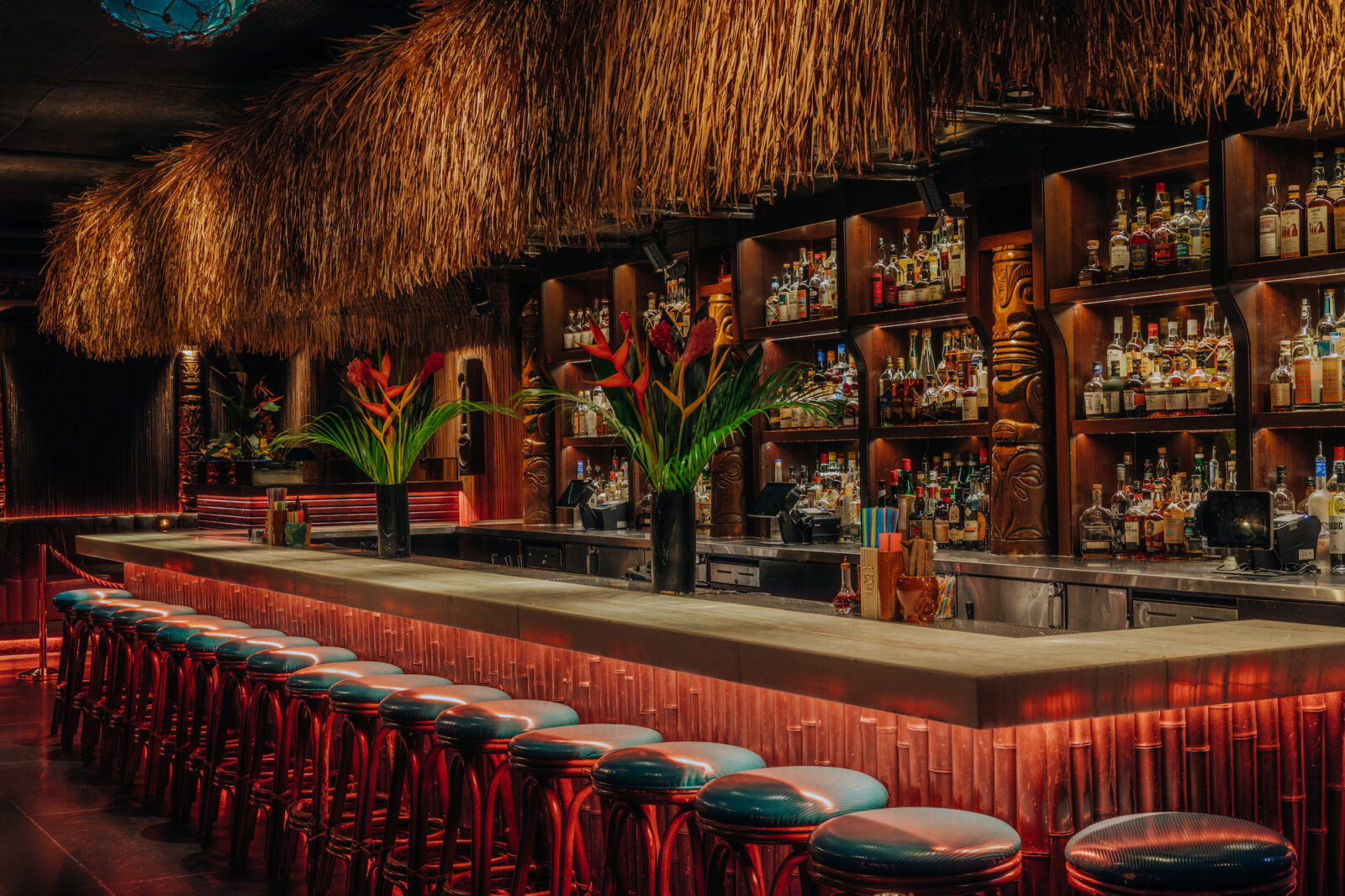
Paul McGee opened Three Dots and a Dash in 2013 in a Chicago alleyway basement, taking the unmarked-entrance secret-bar pattern and applying it to tiki for the first time. A decade later it’s still the Midwest’s most important exotic-cocktail destination—and McGee himself is one of the modern revival’s most accomplished menu builders, with Lost Lake and other concepts to his credit.
Three Dots and a Dash is the Chicago bar you have to learn how to find. The entrance is in the alley off Hubbard Street between Clark and LaSalle—down a flight of stairs, past a tiki-mask-flanked unmarked door, into a windowless basement that opens into 4,500 square feet of full-theater Polynesian Pop interior. Most visitors miss the entrance the first time. That’s deliberate.
Paul McGee, the bar’s founder and original program director, was a graduate of the modern Chicago craft-cocktail scene (he came up through The Whistler and Maude’s Liquor Bar) who decided in 2013 that the city needed a serious tiki bar. He partnered with Lettuce Entertain You restaurant group on the Three Dots build-out and recruited cocktail talent from across the country. The bar that opened was technically the most accomplished exotic-cocktail program in the Midwest from day one—a pre-batched, fresh-juiced, large-format-friendly operation that proved exotic cocktails could scale at high quality in a 250-cover space.
The drink that gave the bar its name—Three Dots and a Dash—is the WWII-era V for Victory cocktail in Morse code, attributed to Donn Beach himself. McGee’s version on the menu became the modern reference recipe for the drink; Smuggler’s Cove and other revival bars adopted the same proportions. Several other Three Dots originals (the Bunny’s Banana Daiquiri, the Flintlock) entered the broader revival vocabulary.
The room is a draw. Mid-century-revivalist tropical decor, the largest visible-from-the-bar fresh-juice operation in any tiki bar in the country (McGee insisted on visible juicing as part of the program’s credibility), and the large-format flaming bowls that arrive at the table with stage smoke and group attention. The vibe sits between Smuggler’s Cove’s curatorial seriousness and Mai-Kai’s theatrical commitment.
McGee himself left Three Dots’ direct operations to open Lost Lake (also in Chicago, also worth visiting) and consults across multiple cocktail concepts. The Three Dots program continues; the bar is profitable, the menu evolves, and the entrance is still in the alley.
Order first
The Three Dots and a Dash (the eponymous). The Bunny’s Banana Daiquiri. The Flintlock. The Saturn. For a group: the volcano bowls if you’re with a crowd.
Why it matters
Three Dots proved exotic cocktails could scale to a 250-cover restaurant operation without losing program quality. McGee’s menu work created several of the modern revival’s reference recipes. The underground-alley entrance pattern (rare in tiki) gives the bar a different register from Smuggler’s Cove or Latitude 29—a speakeasy-meets-tropical that the modern Chicago bar scene has built on.